

How to Calculate Influencer Marketing
Did you know that businesses earn an average of $6.50 for every $1 spent on influencer marketing — yet most brands still struggle to prove it? If you’re investing in influencer campaigns but can’t show clear results to your team, you’re not alone.
In this guide, you’ll discover exactly how to calculate influencer marketing ROI, which metrics actually matter, and which tools make tracking effortless.
Influencer marketing has played an important role in today’s business world. Businesses, startups, and entrepreneurs are investing more in influencer collaborations to increase brand awareness, generate leads, and boost sales. The creator economy is also evolving rapidly, making ROI tracking more important than ever.

What is Influencer Marketing ROI?
Influencer marketing ROI refers to the return a business earns from money spent on influencer campaigns. Simply put, it measures whether the campaign generated enough value compared to its cost.
ROI is important because it helps businesses grow their audience and make better decisions about future collaborations.
True influencer marketing success is measured by business outcomes such as leads, conversions, customer acquisition, and revenue generation.
Why Do Businesses Need to Calculate Influencer Marketing ROI?
There are several reasons why businesses need to know how to calculate influencer marketing ROI. Let’s discuss them briefly.
| Reason | What It Helps You Do |
| Budget Optimization | Identify which campaigns are worth the investment and which are not |
| Better Influencer Selection | Choose creators who deliver real results, not just followers |
| Increased Profitability | Reveal which partnerships generate profit and which drain resources |
| Data-Driven Decision-Making | Make informed decisions by accessing campaign performance data |
| Campaign Performance Evaluation | Compare campaign success across multiple influencers clearly |
How to Calculate Influencer Marketing ROI
Formula for ROI
| ROI (%) = [(Revenue Generated – Campaign Cost) ÷ Campaign Cost] × 100 |
Components of ROI
| Component | Definition |
| Revenue Generated | Total sales or revenue directly attributed to the influencer campaign |
| Campaign Cost | All expenses — influencer fees, ad costs, and equipment used during the shoot |
| Net Profit | Revenue minus total campaign cost |
| ROI Percentage | Shows the profit earned relative to the investment |
Step-by-Step Example
Campaign Details:
- Influencer Fee: $2,000
- Product Samples: $500
- Total Campaign Cost: $2,500
Results:
- Revenue Generated: $10,000
Calculation:
| ROI = [(10,000 − 2,500) ÷ 2,500] × 100 = 300% |
This means the business earned a 300% return on its influencer investment. For every $1 spent, the company generated $4 in revenue, including the original investment.
Key Metrics to Track Alongside ROI
Tracking ROI alone is not enough. These key metrics give you the full picture of your campaign’s performance:
| Metric | What It Measures | Why It Matters |
| Reach | Unique users who saw your content | Shows brand visibility |
| Impressions | Total views including repeated views | Measures content exposure |
| Engagement Rate | Likes, comments, shares, saves | Indicates audience interest |
| Website Traffic | Users visiting your site via influencer links | Tracks referral impact |
| Conversion Rate | Users completing purchases, signups, or inquiries | Measures campaign effectiveness |
| CAC | Cost to acquire each new customer | Shows cost efficiency |
| Revenue Per Influencer | Revenue each creator generated | Helps optimize future collaborations |
Customer Acquisition Cost (CAC) Formula
| CAC = Total Campaign Cost ÷ Number of Customers Acquired |
Engagement Rate — What’s Included
- Likes
- Comments
- Shares
- Saves
High engagement suggests strong audience interest and can signal future purchase intent.
Best Tools for Calculating Influencer Marketing ROI
Using the right tools saves time and makes tracking more accurate. Here are the top platforms:
| Tool | Best For | Key Feature |
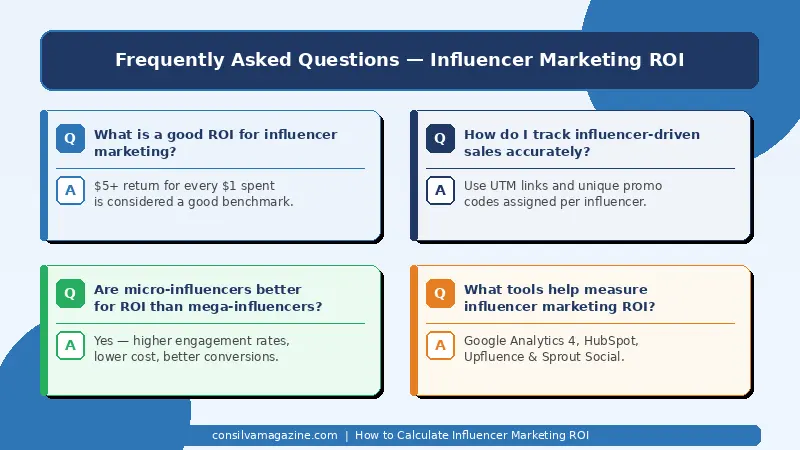
| Google Analytics 4 | Traffic & conversion tracking | Tracks user behavior from influencer campaigns |
| UTM Tracking | Campaign attribution | Identifies campaign-specific traffic sources |
| Shopify Analytics | E-commerce ROI | Measures influencer-driven sales directly |
| HubSpot | Lead & pipeline tracking | Tracks leads, sales pipelines, customer journeys |
| Hootsuite | Social engagement | Measures social performance across platforms |
| Sprout Social | Audience analytics | Provides detailed performance analytics |
| Upfluence | Influencer discovery & ROI | Specialized platform for influencer tracking |
Common Mistakes When Calculating Influencer Marketing ROI
| Mistake | Why It’s a Problem | How to Fix It |
| Tracking Vanity Metrics Only | Likes/comments don’t equal revenue | Track conversions and sales alongside engagement |
| Ignoring Conversion Data | Can’t measure real profit without it | Set up conversion tracking before campaigns launch |
| Not Using UTM Parameters | Attribution becomes impossible | Add UTM links to every influencer post |
| No Clear Campaign Goals | Leads to poor management and wasted budget | Define goals (awareness, sales, leads) upfront |
How to Improve Influencer Marketing ROI
- Know whether your goal is awareness, sales, or lead generation.Define Clear Campaign Objectives —
- Micro and niche influencers often deliver higher engagement and trust.Work with Niche Influencers —
- These improve attribution accuracy significantly.Use Affiliate Links and Discount Codes —
- Continuously monitor campaigns to improve optimization over time.Track Campaigns Consistently —
Future Trends in Influencer Marketing ROI Measurement
| Trend | What It Means for Brands |
| AI-Powered Marketing Analytics | Improved campaign tracking, predictive analysis, and real-time insights |
| Performance-Based Partnerships | Brands will pay creators based on measurable outcomes, not just reach |
| Advanced Attribution Models | Multi-touch attribution will provide clearer conversion tracking |
| Creator Economy Growth | More creators, more niches — better targeting opportunities for brands |
Conclusion
Understanding how to calculate influencer marketing ROI is no longer optional — it’s essential for any business investing in creator partnerships.
Without proper tracking, you risk spending budget without knowing what’s actually working. By using the right formula, tracking the right metrics, and avoiding common mistakes, you can turn influencer marketing into a predictable and profitable growth channel.
Businesses that master influencer marketing ROI measurement will gain a real competitive edge in the rapidly evolving creator economy.
A good ROI for influencer marketing is generally considered $5 or more for every $1 spent. The industry average is around $6.50 per $1, while top-performing brands achieve $20 or more per $1 invested.
It depends on your goal. Sales-focused campaigns can show results within days. Brand awareness campaigns may take 3–6 months to show measurable impact on website traffic, branded search, or follower growth.
Yes, absolutely. Small businesses can use free tools like Google Analytics and UTM links to track traffic and conversions. You don’t need a big budget — even a micro-influencer campaign can be tracked effectively.
Reach is the number of unique people who saw your content. Impressions count every view, including repeated views from the same person. Reach tells you how wide your audience is; impressions tell you how often your content was seen.
Not directly. Likes and comments are engagement metrics, not revenue metrics. They can indicate audience interest and predict future sales, but they should never be the only measure of your campaign’s financial return.
The most reliable methods are UTM tracking links and unique promo codes. These let you directly attribute purchases to a specific influencer, making it easy to calculate exact revenue generated from each campaign.
CAC stands for Customer Acquisition Cost. It tells you how much you spent to acquire one new customer through an influencer campaign. Formula: CAC = Total Campaign Cost ÷ Number of Customers Acquired.
Often, yes. Micro-influencers (10K–100K followers) tend to have more engaged, niche audiences. Their cost per post is lower, and their audience trusts their recommendations more, which can lead to higher conversion rates and better ROI per dollar spent.
IGC is the content (photos, videos, reels) created by influencers for your brand. It affects ROI beyond just the campaign — brands can repurpose IGC for paid ads, emails, and website pages, saving significant content production costs while improving ad performance.
It depends on your budget and goal. Multiple micro-influencers across different niches often deliver better overall ROI than one mega-influencer. Diversifying your influencer mix also reduces risk if one campaign underperforms.