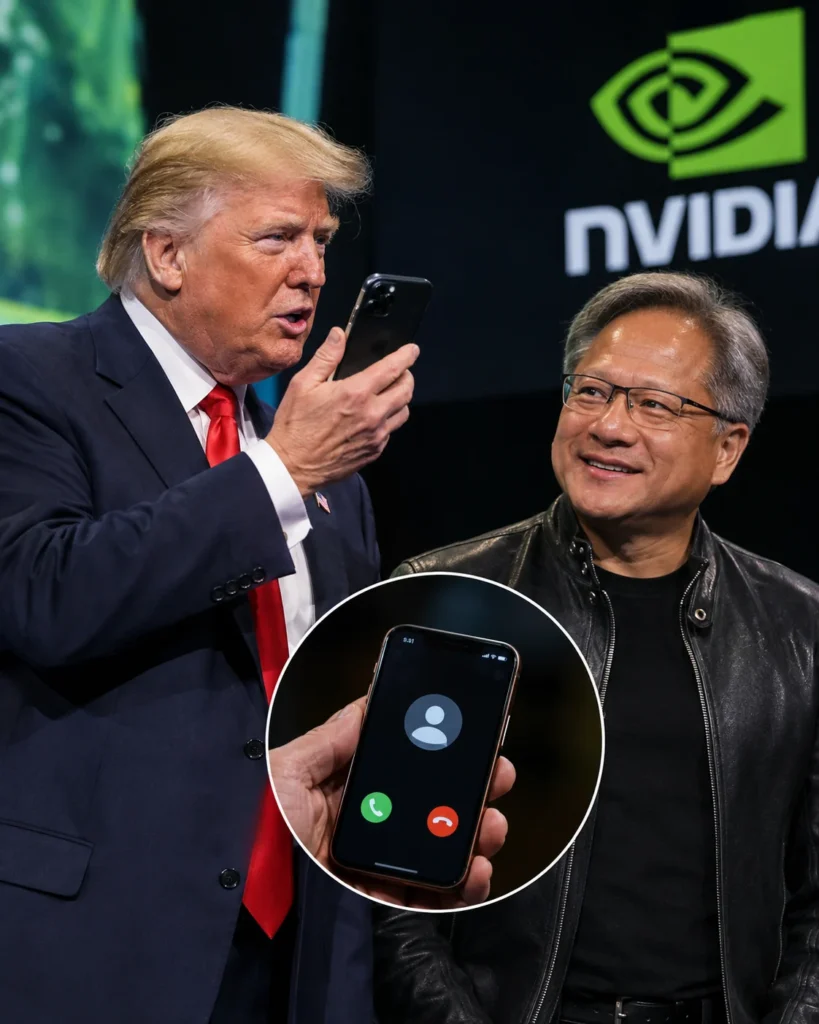
Jensen Huang was in the middle of a panel discussion Monday at the All-In Summit in Los Angeles when his phone rang. Not a text, not a scheduled bit — an actual incoming call, live, in front of a packed room of investors and tech executives. He glanced at the screen, told the crowd “I’m onstage with the besties,” and then did something most CEOs would never risk doing with a sitting president on the line: he put it on speaker.
That single decision turned a routine industry panel into the most talked-about five minutes of the conference — and it wasn’t only because of who was calling.
An Unscheduled Call, a Very Scheduled Message
The voice on the other end was Donald Trump’s. Huang, functioning more like a stagehand than a Fortune 500 CEO in that moment, actually had to ask someone nearby for a spare microphone so the audience could hear both sides of the conversation clearly. Once that was sorted, Trump didn’t waste time on small talk. He went straight at the subject that’s been dominating tech conversations all year: how worried anyone should actually be about artificial intelligence.
Trump’s answer was blunt. He called the growing anxiety around AI a “hoax,” and argued that the people pushing hardest for caution weren’t acting out of genuine concern — they were, in his telling, either aligned with Chinese interests or playing a political game. “The robots will not be taking over,” he told Huang and the room. “The whole thing is a hoax.” He went further, comparing the scale of AI’s importance to the early internet, only bigger, and framing any deliberate slowdown as a mistake the country couldn’t afford to make.
It’s worth remembering what prompted this line of conversation in the first place. Just days earlier, Anthropic’s CEO Dario Amodei had published a widely discussed essay arguing that AI’s capabilities are advancing faster than the world’s ability to understand or safely manage them, and that the industry should deliberately pace itself rather than race ahead unchecked. Elon Musk and OpenAI’s Sam Altman had both signaled some agreement with that caution. Huang, notably, has not.
Onstage, in the run-up to Trump’s call, Huang and the All-In hosts had already been discussing Amodei’s argument directly — which made Trump’s call feel less like an interruption and more like a rebuttal arriving in real time. Trump leaned into that framing, telling Huang, “The great thing about life is Jensen can develop the most complex computer chip in the world … but he can’t figure out how to put you on speaker” — a jab Huang absorbed good-naturedly, given that he was, at that exact moment, holding the phone that would end up drawing almost as much attention as the conversation itself.
The Phone Everyone Was Trying to Identify
While the AI-safety exchange was happening, a good chunk of the internet’s attention drifted somewhere else entirely: what, exactly, was Huang holding?
Early reports — including an initial version of this story — identified it as an unreleased Apple foldable device. That was wrong, and worth correcting plainly rather than quietly editing around. Later reporting, including detailed coverage out of South Korea, identified the device as Samsung’s Galaxy Z Fold 8, the company’s newest foldable phone. Huang unfolded it on stage to switch on the speaker function, which is what put the device in full view of a room full of people who, it turns out, notice hardware just as quickly as they notice presidential phone calls.
It’s a small detail, but not a meaningless one. A phone in a CEO’s hand at a moment like this doesn’t stay just a phone — it becomes a signal, intentional or not, about where that executive’s loyalties or interests sit. In this case, the read is less about any single company and more about how much attention gets paid to the smallest visual details when the stakes of the conversation are this high.
Why Huang’s Position Isn’t Exactly Neutral
None of this happened in a vacuum. Nvidia’s entire business is built on the assumption that AI development keeps accelerating — the more compute the industry believes it needs, the more chips get ordered, and Nvidia is the company most of that demand flows through. A public figure whose company profits directly from AI’s pace has an obvious reason to downplay arguments for slowing that pace down, regardless of what he privately believes about the underlying risk.
That doesn’t necessarily mean Huang’s position is insincere. It does mean it’s not disinterested, and that distinction matters when evaluating what got said on that stage. Nvidia’s stock has climbed roughly a third over the past year, even after slipping a few percentage points on the day of the call — a reminder that every public comment Huang makes about AI’s trajectory lands on a market that’s watching just as closely as any conference audience.
What This Moment Actually Captured
Strip away the phone mix-up and the political theater, and what’s left is a fairly clear snapshot of where things stand right now: a sitting president publicly dismissing AI safety concerns as overblown, live, on the phone with the CEO whose company benefits most from AI moving as fast as possible — while, a few feet away, a room full of people were just as fascinated by which company’s hardware he happened to be holding.
Both things were true at once, and neither one canceled the other out. That’s probably the most accurate way to describe where the AI conversation is right now: serious enough to involve the president directly, and yet still, in the same breath, absorbed into the same spectacle-driven attention economy as everything else in tech.