
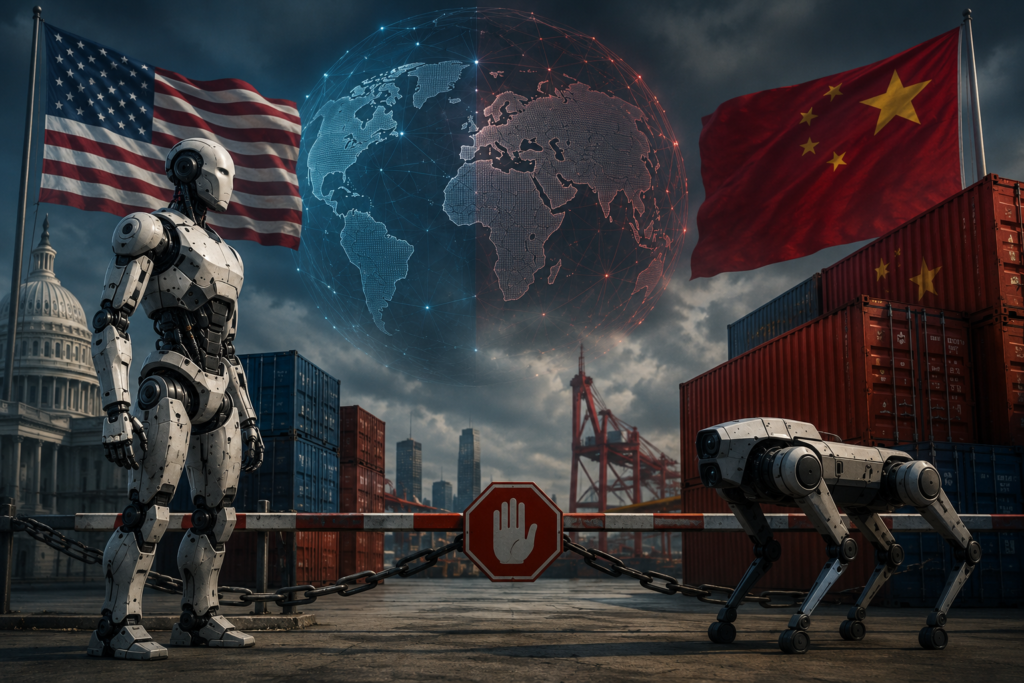
How Washington’s newest trade barrier made these hulking machines the latest in the U.S.-China tech cold war
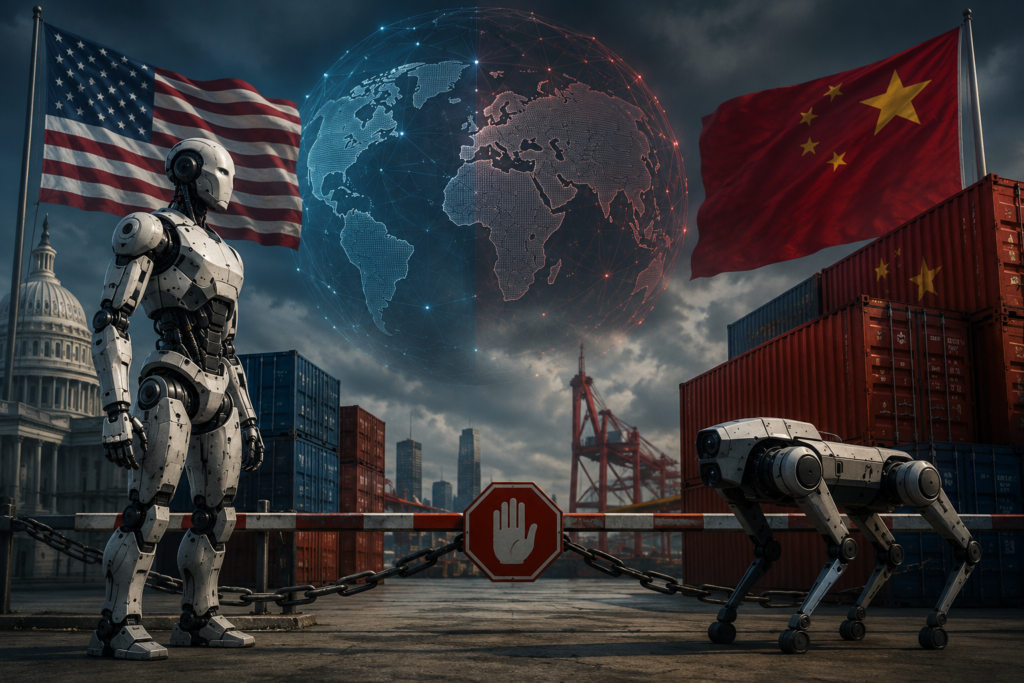
There’s always a moment in a technology’s lifespan when it goes from a cool novelty to a scary threat. It happened with cars, it happened with the internet, and now it’s happening to robots.This week, the feds drew a bright red line around a certain class of machines (namely, humanoid and quadrupedal robots) and made it illegal to import them, for now.They didn’t exactly go soft on the robots, either. Starting today, new imports of these machines are banned, for national security reasons, says the FCC. But what gives?
The New Rules Explained
The FCC (Federal Communications Commission) – along with other federal agencies – took this step, and it wasn’t without controversy. In addition to robots, the feds drew a line around power inverters, those unspectacular devices that convert AC to DC or vice versa. They’re used in solar power systems and in the charging equipment for electric cars, among other places.
The reason given for the action was that it’s the FCC’s responsibility to ensure the reliability of communications infrastructure and to safeguard the U.S. supply chain from potential threats.
What does this actually mean in practical terms?
- It is now illegal to import new humanoid or quadrupedal robots or power inverters from the manufacturers listed in the documents below.
- However, any robots already in the United States that have been authorized for use are not affected.
In other words, there’s no rollback of previously authorized robots. Nothing changes for them, other than potentially being placed in legal limbo if new rules are introduced in the future.
The Two Scenarios, Summed Up
If you want to understand why this happened, consider these two scenarios, both of which policymakers seem to find unacceptable.
The first involves power inverters. Suppose that an inverter has been installed in a facility containing critical infrastructure, say, a government installation or a power grid control center. Suppose further that a foreign government retains access to that inverter remotely. Malicious actors could exploit this backdoor to cause a blackout or perform some other form of corporate espionage without anyone’s knowledge.
The second scenario involves robots. This one seems far-fetched, but it’s right in line with how the feds are thinking. Imagine a household or business setting up a humanoid robot or a quadrupedal robot to perform various tasks in and around the home. This robot has sensors and cameras and other networking features, all of which could be used to monitor the surroundings and report back to the manufacturer. Even more worrying, hackers could use the robot as a surveillance device without the owners’ consent.
None of this may have happened yet, but these fears are enough for the U.S. administration to take action. In effect, any use of such robots in the United States is now prohibited unless explicitly authorized by the government.
The Chinese Respond in Kind
The Chinese Embassy in Washington was not pleased to hear about the new restrictions. It accused the U.S. of using this as an excuse to pursue protectionist policies and called upon the international community to oppose what it described as a “hegemonic attitude” towards artificial intelligence development. Beijing has warned that it will take measures to protect Chinese companies in light of these protectionist policies.
Meanwhile, representatives of robot manufacturers based in China, including Unitree, UBTech, and AgiBot, have remained silent.
Why It’s Happening Now
If you follow the news about the U.S. and China, you realize that this kind of economic and technological cold war has been going on for years. The measures taken against Chinese imports recently include:
- tariffs on electric vehicles to the point that they’re effectively unwelcomed guests in the U.S. market
- export controls on cutting-edge semiconductors to slow down China’s technological development
- warnings from the Treasury Department about potential sanctions against Chinese firms involved in industrial-scale intellectual property theft in the field of artificial intelligence, which Beijing strongly denies
…and the list goes on. The competition between the two countries has led to a series of confrontations, each of which seems to be a prelude to a larger conflict. However, if you look closely, it’s entirely possible that all these steps are part of a coordinated effort to impose broad restrictions on China’s economic and technological development.
Why Robots, Specifically?
It’s no coincidence that robots are at the heart of this latest confrontation.
Chinese robot manufacturers are currently investing heavily in research and development, and a number of them are preparing to release humanoid robots in the near future. Some experts believe that the robots being developed in China could surpass even the most advanced models developed by Tesla and Boston Dynamics.
For American manufacturers, such a scenario is unacceptable, because Chinese robots are set to displace their domestic counterparts on the market. It’s one thing for Chinese competitors to appear on the horizon, and quite another for them to actively promote their robotic platforms. By drawing a red line around these foreign machines, the feds hope to halt the expansion of China’s robotics industry before it begins.
What Comes Next?
At this point, it’s impossible to say with any degree of confidence. This could very well be the beginning of a long-dormant protectionist campaign, or it could be the start of something bigger. Perhaps the U.S. economy is preparing for a prolonged confrontation with China, which would explain why steps are being taken to curb the growth of the robotic industry. On the other hand, the measures taken by the FCC may only apply to one specific segment of the economy. It remains to be seen how these policies will affect businesses and consumers in the future.
The FCC has warned that this step may be overturned if new information emerges, and the Chinese Embassy has warned that the situation will be closely monitored. In other words, this is only the beginning of the story.