

10 Best Mutual Funds to Invest in India 2026
Introduction
India’s mutual fund industry has crossed ₹73 lakh crore in Assets Under Management (AUM) in 2026 — and yet, millions of investors still struggle to pick the right fund. With over 40 SEBI-regulated categories and hundreds of schemes available, choosing the best mutual funds to invest in India 2026 feels overwhelming for most people.
Should you go for large cap stability or small cap aggression? Is a SIP better than a lumpsum? Does your existing fund even match your financial goal?
If these questions sound familiar, you are not alone.
In this guide, you will discover the top-performing funds across every major category, a step-by-step method to choose what suits you, and the most common mistakes investors make — without needing a financial advisor to decode the jargon.
Written by Shivi Bajpai, Sub-Editor at Consilva Magazine — India’s fastest-growing business publication covering startup founders and business leaders shaping the country’s future.

What Are Mutual Funds and Why Should You Invest in 2026?
Mutual funds have become the most accessible way for everyday Indians to grow wealth without picking individual stocks. In 2026, SEBI’s updated February framework has reorganised all schemes into 40 structured categories — making fund comparison clearer and more investor-friendly than ever before.
A mutual fund pools money from many investors to buy a diversified portfolio of stocks, bonds, or other securities. It is managed by a professional fund manager. Mutual funds in India are regulated by SEBI. They suit investors who want diversification, liquidity, and long-term wealth creation without selecting individual stocks.
According to AMFI’s March 2026 data, SIP contributions reached ₹32,087 crore in a single month — the 61st consecutive month of positive equity net inflows. This tells you one thing clearly: disciplined investors are not waiting for the “perfect time.” They are investing consistently, month after month.
Types of Mutual Funds in India — Quick Reference
| Fund Type | Best For | Risk Level | Ideal Horizon |
|---|---|---|---|
| Large Cap Funds | Stable, consistent growth | Medium | 5+ Years |
| Mid Cap Funds | Higher growth potential | High | 5–7 Years |
| Small Cap Funds | Aggressive wealth creation | Very High | 7+ Years |
| Flexi Cap Funds | Balanced growth across caps | Medium-High | 5+ Years |
| ELSS | Tax saving under Section 80C | Medium-High | 3+ Years |
| Hybrid Funds | Conservative balanced growth | Low-Medium | 3–5 Years |
| Debt Funds | Capital preservation | Low | Under 3 Years |
| Index Funds | Passive, low-cost investing | Medium | 5+ Years |
Best Mutual Funds to Invest in India 2026 — Category-Wise Picks
Choosing funds category-wise makes investing simpler. Here are the top-performing schemes across each major category, with verified data points to help you compare.
Large Cap Mutual Funds — Stability for the Long Run
Large cap funds invest in India’s top companies by market capitalisation. These are businesses with established revenue, strong governance, and resilience through market cycles. If you prioritise steady, lower-volatility growth, large cap funds are your starting point.
Large cap mutual funds invest in the top 100 companies by market capitalisation listed on Indian exchanges. They offer lower volatility than mid or small cap funds. They are best suited for conservative equity investors with a horizon of five years or more.
| Fund Name | AUM | 3Y Returns | 5Y Returns | Expense Ratio | Min. SIP |
|---|---|---|---|---|---|
| Nippon India Large Cap Fund | ₹35,000+ Cr | 15.24% | 16.27% | 0.87% | ₹100 |
| Canara Robeco Bluechip Equity Fund | ₹14,000+ Cr | 13.8% | 15.4% | 0.42% | ₹1,000 |
Mid Cap Mutual Funds — Growth with Calculated Risk
Mid cap funds focus on companies ranked 101st to 250th by market cap. These are businesses in their growth phase — not as stable as large caps, but with significantly higher upside potential. They are among the top performing mutual fund categories for investors with a 5 to 7 year horizon.
Mid cap mutual funds invest in companies ranked 101st to 250th by market capitalisation. They carry higher volatility than large cap funds. They are best suited for investors with a five to seven year investment horizon who can tolerate short-term market swings for higher long-term returns.
| Fund Name | AUM | 3Y Returns | 5Y Returns | Expense Ratio | Min. SIP |
|---|---|---|---|---|---|
| HDFC Mid Cap Fund | ₹76,000 Cr | 17.4% | 22.2% | 0.76% | ₹100 |
| Motilal Oswal Midcap Fund | ₹28,000 Cr | 18.8% | 23.14% | 0.65% | ₹500 |
Small Cap Mutual Funds — High Risk, High Reward
Small cap funds invest in companies outside the top 250 by market cap. They can generate exceptional returns over the long term, but they also carry the highest volatility. These funds are best suited for aggressive investors who can stay invested for seven years or more without panic-selling during corrections.
Small cap mutual funds invest in companies ranked beyond 250th by market capitalisation in India. They offer the highest growth potential among equity fund categories. They carry very high risk and are suitable only for investors with a minimum seven-year horizon and high risk tolerance.
| Fund Name | AUM | 3Y Returns | 5Y Returns | Expense Ratio | Min. SIP |
|---|---|---|---|---|---|
| Nippon India Small Cap Fund | ₹67,000 Cr | 19.92% | 21.7% | 0.73% | ₹100 |
| Quant Small Cap Fund | ₹30,000 Cr | 21.71% | 21.24% | 0.61% | ₹1,000 |
Flexi Cap Mutual Funds — Best Equity Funds for Most Investors
Among the most popular best equity mutual funds in India in 2026, flexi cap funds give fund managers the freedom to move money across large, mid, and small cap stocks based on market conditions. This dynamic allocation makes them among the most versatile investment options available.
Flexi cap mutual funds can invest across large, mid, and small cap stocks with no fixed allocation limits. Fund managers shift capital based on market valuations. They offer balanced risk-adjusted returns and are suitable for investors seeking diversified equity exposure in a single fund.
| Fund Name | AUM | 3Y Returns | 5Y Returns | Expense Ratio | Min. SIP |
|---|---|---|---|---|---|
| Parag Parikh Flexi Cap Fund | ₹48,000 Cr | 23.65% | 21.80% | 0.74% | ₹1,000 |
| HDFC Flexi Cap Fund | ₹1,01,822 Cr | 17.9% | 18.3% | 0.80% | ₹1,000 |
PSU & Thematic Funds — For Sector-Specific Bets
Thematic and PSU funds focus on specific sectors or government enterprises. They can deliver strong returns during sector-specific rallies — as seen with defence and PSU themes in 2024–25 — but carry concentrated risk compared to diversified equity funds.
PSU and thematic mutual funds invest in companies belonging to a specific sector or government enterprise category. They outperform during sector rallies but carry higher concentration risk. They are suitable for experienced investors who understand sector cycles and hold a long-term view.
| Fund Name | AUM | 3Y Returns | 5Y Returns | Expense Ratio | Min. SIP |
|---|---|---|---|---|---|
| SBI PSU Direct Plan Growth | ₹5,000 Cr | 30.37% | 24.72% | 0.89% | ₹500 |
Best SIP Mutual Funds to Invest in 2026
A Systematic Investment Plan (SIP) lets you invest a fixed amount every month into a mutual fund of your choice. It removes the need to “time the market” and builds wealth steadily through rupee cost averaging.
A SIP (Systematic Investment Plan) is a method of investing a fixed amount at regular intervals — typically monthly — into a mutual fund scheme. It enables rupee cost averaging, reduces the impact of market volatility, and builds long-term wealth through compounding. SIPs can be started with as little as ₹100 per month.
According to a 25-year SIP study by Value Research, equity SIPs with investment horizons of seven years or more have historically delivered strong outcomes and rarely produced negative returns. This makes SIP the most disciplined way to invest in mutual funds in 2026 — especially for salaried investors.
| Fund Name | SIP Returns (3Y) | Min. SIP Amount | Best For |
|---|---|---|---|
| Parag Parikh Flexi Cap | 23%+ | ₹1,000 | Long-term growth |
| HDFC Flexi Cap | 29%+ | ₹1,000 | Wealth creation |
| Motilal Oswal Large & Midcap | 25.21% | ₹500 | Aggressive growth |
| Nippon India Small Cap | 19.92% | ₹100 | High-risk long term |
Small, consistent SIP investments — even ₹500 a month — compounded over 10 to 15 years can build a meaningful corpus. Discipline matters more than the amount you start with.
How to Choose the Best Mutual Fund for You — 6 Steps
Choosing a fund becomes much easier when you follow a goal-based approach rather than chasing last year’s top performers. Here is a practical six-step framework.
To choose the best mutual fund in India, define your financial goal first, then assess your risk tolerance, investment horizon, and whether you prefer direct or regular plans. Use SEBI’s 40-category framework to shortlist funds, then compare expense ratios and Value Research ratings before investing.
Step 1 — Define Your Financial Goal
Before choosing any fund, ask yourself: what is this money for? Retirement? A child’s education? Buying a home in five years? Your goal determines your category, your horizon, and how much risk you can afford to take.
Step 2 — Understand Your Risk Comfort Level
Every investor has a different relationship with market ups and downs:
| Risk Tolerance | Suitable Fund Type |
|---|---|
| Low | Debt Funds / Hybrid Funds |
| Medium | Large Cap / Flexi Cap |
| High | Mid Cap / Small Cap |
Step 3 — Decide Your Investment Horizon
How long can you stay invested without needing the money?
| Time Horizon | Recommended Category |
|---|---|
| Under 3 years | Debt Funds |
| 3–5 years | Hybrid / ELSS |
| 5+ years | Equity Funds |
Step 4 — Always Choose Direct Plans
Direct plans have 0.5% to 1.5% lower expense ratios than regular plans because they cut out distributor commissions. Over 10 to 15 years, this difference in cost compounds into a significant return advantage.
Step 5 — Use SEBI’s 40-Category Framework
SEBI’s revised February 2026 circular organises all mutual funds into 40 structured categories. This framework removes confusion when comparing schemes — ensuring you compare large cap funds with large cap funds, not with a thematic or hybrid scheme.
Step 6 — Check Expense Ratio, Ratings & Consistency
Before finalising any fund, check these four parameters on platforms like Value Research or Morningstar:
| Parameter | Why It Matters |
|---|---|
| Expense Ratio | Lower costs = higher net returns over time |
| Portfolio Quality | Fund holdings should match stated mandate |
| Return Consistency | Look at 3Y and 5Y — not just 1Y performance |
| Risk-Adjusted Returns | Sharpe ratio tells you return per unit of risk |
Goal-to-Fund Mapping Table
| Investment Goal | Recommended Fund Type | Risk | Horizon |
|---|---|---|---|
| Wealth Creation | Flexi Cap / Mid Cap | Medium-High | 5–10 Years |
| Retirement | Large Cap / Index | Medium | 10+ Years |
| Tax Saving | ELSS | Medium-High | 3+ Years |
| Emergency Reserve | Debt / Liquid Fund | Low | Under 3 Years |
Common Mistakes to Avoid When Investing in Mutual Funds
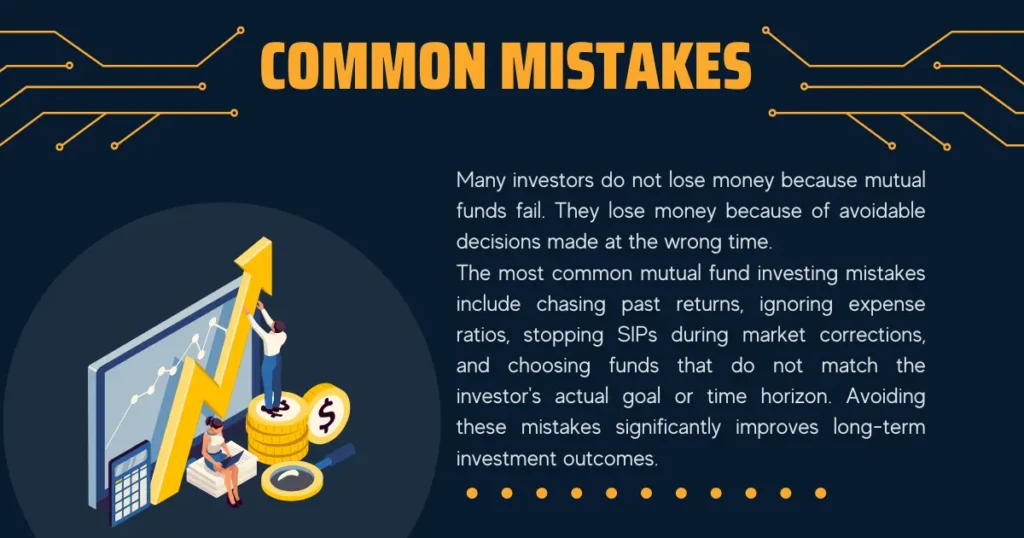
Many investors do not lose money because mutual funds fail. They lose money because of avoidable decisions made at the wrong time.
The most common mutual fund investing mistakes include chasing past returns, ignoring expense ratios, stopping SIPs during market corrections, and choosing funds that do not match the investor’s actual goal or time horizon. Avoiding these mistakes significantly improves long-term investment outcomes.
Chasing Last Year’s Top Performers
A fund that topped the charts in 2024 may not repeat in 2026. Returns rotate across categories. Always look at three-year and five-year consistency across different market cycles — not just recent performance during a bull run.
Ignoring the Expense Ratio
A 1% difference in expense ratio may seem small on paper. Over 20 years on a ₹10 lakh investment, it can mean a difference of ₹5–8 lakh in final corpus. Always compare expense ratios, especially when choosing between two similar funds in the same category.
Stopping Your SIP During Market Corrections
Market corrections feel uncomfortable — but they are actually the best time to continue your SIP. Stopping during a crash locks in your losses and removes your ability to buy more units at lower prices. Stay the course. SIP discipline during downturns is what builds real long-term wealth.
Investing Without a Clear Goal
Choosing a small cap fund for a goal that is two years away is a mismatch between risk and time horizon. Your fund type must match your goal — not your neighbour’s recommendation or a viral social media post.
Trust & Authority — What Experienced Investors Know
“Investors who stay systematic during corrections almost always outperform those who try to time the market. SIP discipline is the single most underrated wealth-building tool available to Indian retail investors.” — AR Research Team, Anand Rathi, 2026
At Consilva Magazine, we have tracked how India’s most financially aware founders and business leaders approach wealth building. The common thread is not the “hottest” fund — it is consistency, low-cost direct plans, and a goal-matched portfolio held through multiple market cycles.
India’s mutual fund AUM has grown from ₹38 lakh crore in FY23 to ₹73+ lakh crore in 2026. That 90%+ growth in three years reflects not just market appreciation — it reflects a fundamental shift in how Indians are thinking about savings and investment.
Frequently Asked Questions
There is no single “best” mutual fund for everyone. The right fund depends on your goal, risk appetite, and investment horizon. Consistently strong performers include Parag Parikh Flexi Cap, Nippon India Small Cap, and HDFC Mid Cap Fund.
For salaried investors with regular monthly income, SIP is more beneficial. It is less risky, more disciplined, and benefits from rupee cost averaging. Lumpsum works better when markets have corrected significantly and you have surplus capital ready to deploy
Small cap and thematic mutual funds have historically delivered the highest returns over long periods. However, they also carry the highest risk. Funds like Quant Small Cap and Nippon India Small Cap have delivered 21%+ over five years.
Mutual funds in India are regulated by SEBI — one of Asia’s most active securities regulators. While market-linked funds carry investment risk, the regulatory framework ensures transparency, daily NAV disclosure, and strict fund categorisation. They are among the safest market-linked investment products available.
Most funds allow SIP investments starting from ₹100 to ₹500 per month. You do not need a large sum to begin. Starting small and staying consistent matters far more than waiting until you have a bigger amount.
.
Conclusion
The best mutual funds to invest in India 2026 are not the ones with the flashiest recent returns. They are the ones that match your goal, suit your risk tolerance, and have a track record of consistency across market cycles.
Large cap funds offer safety. Mid and small cap funds offer growth. Flexi cap funds offer diversification. And SIPs offer discipline — which is the most valuable edge any investor can have.
Start small, stay consistent, and let compounding do the rest. The best time to start investing was yesterday. The second best time is today.
Keep Reading on Consilva Magazine
If this guide helped you understand mutual funds better, you will find these articles equally valuable:
- 📈 10 Financial Management Tips for Business Owners in 2026 — Smart money habits every founder and business owner needs in 2026.
- ⚠️ 10 Financial Planning Mistakes to Avoid in 2026 — Common errors that silently destroy long-term wealth.
- 💰 Financial Success, Emotional Stress: Who’s Really in Control? — The psychology behind smart financial decisions.
- 🚀 15 Best Small Business Ideas for Beginners in 2026 — Low investment, high profit ideas to build your own income stream.
- 🏆 How to Build Leadership Skills as a Startup Founder — 10 proven strategies for founders building teams in 2026.
👉 Explore more at consilvamagazine.com
About the Author
Shivi Bajpai is Sub-Editor at Consilva Magazine — India’s fastest-growing digital business publication covering startups, finance, AI, and business leadership. Shivi writes on finance, technology, and startup culture with a style that is accessible, research-backed, and audience-friendly. Her work reaches both Indian and international business readers.Share