
Why the Cockroach Janta Party Is Gaining Attention: Key Issues Behind Its Rise
Why the Cockroach Janta Party Is Gaining Attention: Key Issues Behind Its Rise
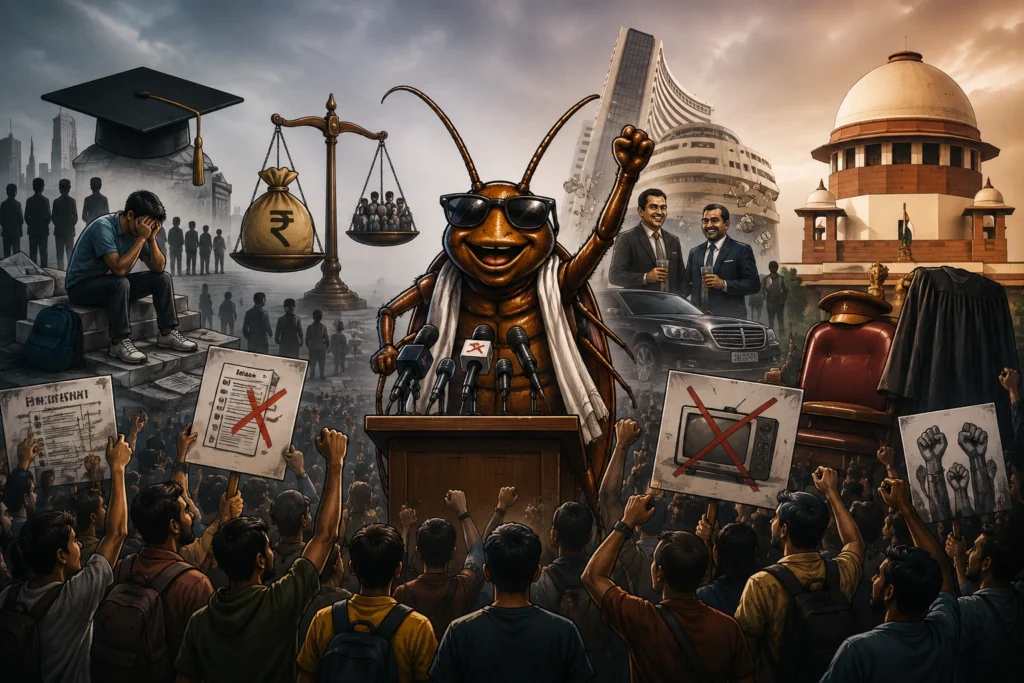
The Cockroach Janta Party (CJP) is an Indian satirical political movement which was founded on 16 may 2026 by Abhijeet Dipke, a former social media campaigner and volunteer for the Aam Aadmi Party. The party grown as a satricial response to remarks made by Chief Justice of India Surya Kant on 15 May 2026, in which he compared unemployed youth to “cockroaches” and “parasites of society”. Reports indicated that supporters of the Cockroach Janta Party were considering contesting the upcoming Bankipur Assembly by-election in Bihar. Within days of its founding, the movement gamered and now it has reached 12.6 million followers within 3 days only.
Origin of this party
During a Supreme Court hearing on 15 May 2026, Chief Justice Surya Kant remarked: “”There are youngsters like cockroaches, who don’t get any employment or have any place in profession. Some of them become media, some of them become social media, RTI activists and other activists and they start attacking everyone.”
On the next day, Abhijeet Dipke announced that launch of a “platform for all the cockroaches out there” on X (Formerly Twitter), listing eligibility criteria as unemployed, lazy, chronically online and making the ability to rant professionally.
The party’s website, Cockroach Janta Party went live on 16 May under the tagline “Voice of the Lazy & Unemployed. Within 48 hours, the movement claimed over 40,000 registered members, with later reports suggesting figures exceeding 70,000. The movement has since spread to several states, including Bihar, Madhya Pradesh, Uttar Pradesh, Jammu and Kashmir (union territory), and Himachal Pradesh.
Response from the Chief Justice
Now after seeing these things, Chief Justice Surya Kant issued a clarification on 16 May, in which he states that his remarks have been misquoted. He said that he was specifically criticising individuals who had entered the legal profession using fake and bogus degrees, not the country’s unemployed youth.
“Not only am I proud of our presence and future human resource, but every youth of India inspires me. I see them as the pillars of a developed India,” he said.
Dipke responded to the clarification on X, stating. “I have my differences with the PM but I believe the CJI has no right to insult him. Not having a legitimate degree does not give anyone the right to call fellow citizens ‘parasites.”
Membership of this party
The eligibility criteria for joining the CJP is:
- Unemployed (“By force, by choice, or by principle”)
- Lazy (“refers only to physical activity”)
- Stays active on social media (“at least 11 hours daily, including bathroom breaks”)
- Ability to rant professionally
The party states that religion, caste and gender are not considered in the membership process
Ideology of this party
The CJP describes itself as “a political front of the youth, by the youth, for the youth — Secular, Socialist, Democratic, and Lazy.
Underlying Issues
While the Cockroach Janta Party began as a satirical response to Chief Justice Surya Kant’s remarks, commentators and analysts have identified several deeper structural issues that explain the movement’s rapid growth and resonance among Indian youth.
1. Unemployement
India faces a high graduate unemployment rate, with manyeducated youth struggling to find jobs.
2. Examination Paper Leaks
Repeated Exam Paper Leaks, including the NEET controversy, have increased student frustration and mistrust in the system. The CJP voiced this anger through songs, protests, and support for affected students.
3. Income Inequality and Crony Capitalism
Critics argue that wealth and economic benefits are concentrated among a few powerful industrialists. The CJP challenges this system by opposing corporate influence and demanding greater accountability.
4. Political Privilege and Institutional Trust
Concerns have grown over retire judges receiving political positions, raising questions about institutional independence. The CJP highlights this issue to demand stronger separation between judiciary and politics.