

Each month a bunch of founders decide that the world needs another company. Most of them will become insolvent and stop operating in a few years. Some will not. It is impossible to know which ones are going to make it ahead of time, but it is possible to single out the founders asking the right questions. And in July 2026 there are several interesting ones.
From space to short-haul planes, from GPU cloud to hyperlocal social media and AI coding assistants. A range of industries, but they all have something in common. India’s startup founders are realizing they do not have to tackle exclusively light weight problems anymore. More and more often we see Indians pursue careers and opportunities in capital and infrastructure intensive industries.
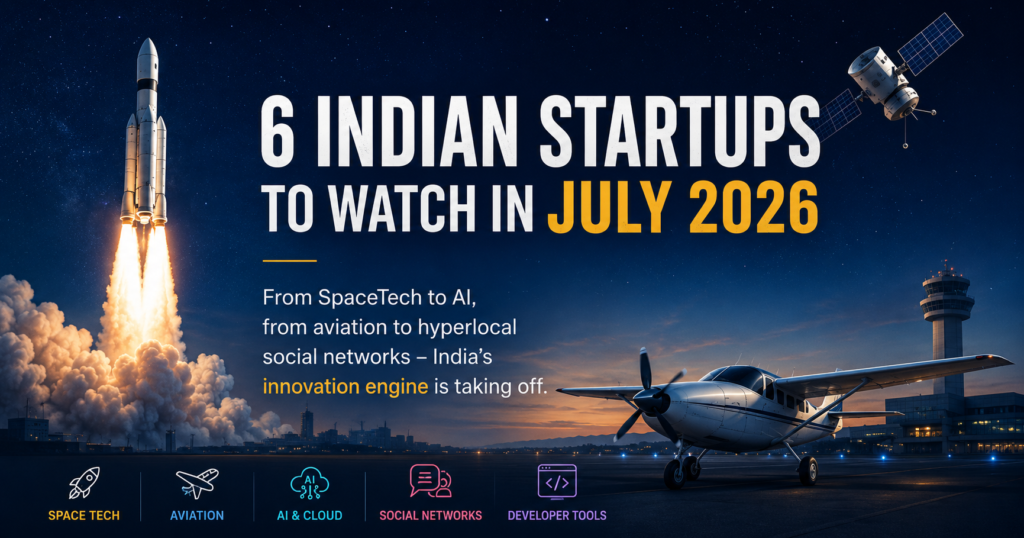
Let me tell you more about the 6 interesting Indian startups we saw appear in July 2026.
1. Grahaa Space: Going to Space
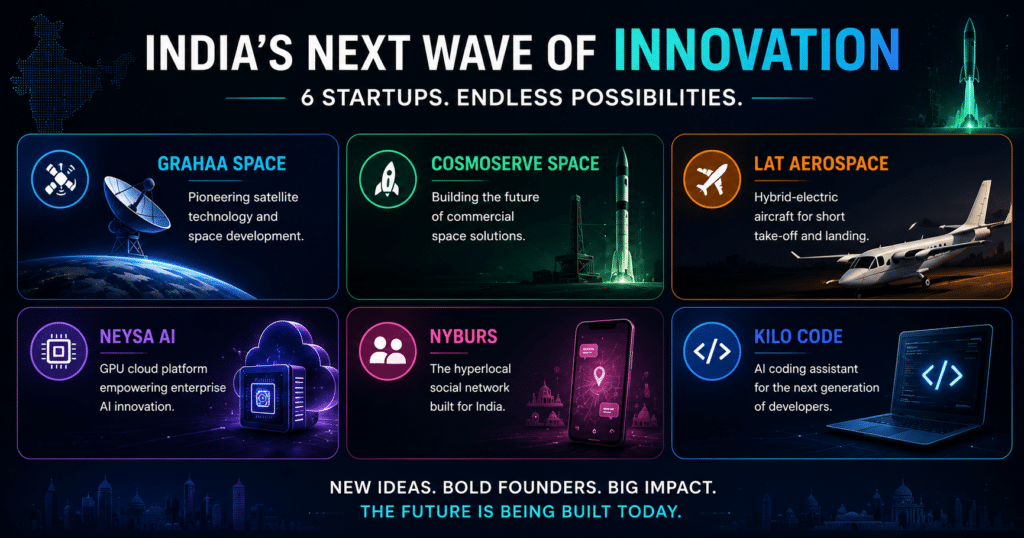
India used to be a country were space related activities mostly implied the work of ISRO, but this is rapidly changing. Grahaa Space is one of the companies trying to capitalize on this shift. The firm’s main activity is satellite technology and space development. They already boast about having flown a payload on board Vikram-1, the Skyroot Aerospace rocket.
Says Gaurav Seth, co-founder and as of now the only named founder of Grahaa Space. No CEO named yet, as the company is still in its infancy.
Why Grahaa Space is Interesting:
- India’s private space industry is a recent phenomenon, and Grahaa Space is one of the first known startups in this space (no pun intended).
- Their activity in the domain of satellite development makes them a good candidate for picking up government and commercial contracts.
- Their name recognition is boosted by virtue of having already launched a payload.
2. Cosmoserve Space: Space Industry Contender
Another company in the Indian space industry is Cosmoserve Space, which works on similar principles to Grahaa Space.
This company is still fairly secretive about their inner workings, with no confirmed founder or CEO yet.
Why Cosmoserve Space is Interesting:
- India is a recent entrant in the market of commercial space flights. This creates opportunities for the firms involved, as well as the ones selling supporting infrastructure.
- The country’s commercial space industry is still nascent, and its future is unclear. Its existence opens many opportunities.
3. LAT Aerospace: Revolutionizing Connectivity
LAT Aerospace works on hybrid-electric aircrafts for short take-off and landing, targeting India’s regional airports. Its founder and CEO Surobhi Das has partnered with the well-known businessman Deepinder Goyal, co-founder of Zomato and Eternal. He was also previously a co-founder of LAT Aerospace, and as of the founding of this new company the original team still leads.
Why LAT Aerospace is Interesting:
- Hybrid-electric aircraft engines are an innovative development in their own right.
- The design goals of the company address a real pain point. The regional airports of India are crying out for investment.
- LAT Aerospace is able to leverage the name and credibility of Deepinder Goyal, a serious businessman with serious resources.
4. Neysa AI: The Founders of the AI Cloud
Most AI startups are either developing applications on the existing model of some bigger company, or are using some existing infrastructure to build applications on top of. Neysa AI is a company that targets the middle: providing an infrastructure for enterprises to develop and host their own generative AI applications and models.
The co-founder and CEO of Neysa AI is Sharad Sanghi, with Anindya Das listed as the co-founder and CTO.
Why Neysa AI is Interesting:
- Infrastructure tends to be a boring category, but one of the few promising ones available in 2026.
- A GPU cloud platform targets a real need and helps address a current technological bottleneck.
- Enterprise adoption of generative AI is a growing vertical, and infrastructure plays a part in it either way.
5. Nyburs: The Hyperlocal Social Network
Instead of building a social network around the world, Nyburs has turned its attention to local communities. It has been designed for a hyperlocal audience, and the company lists Indian regional languages as its target from the start.
The founder and CEO of Nyburs is Navin Sharma, and he has a co-founder in Vishal Chaudhary.
Why Nyburs is Interesting:
- There are many social networks around, but they are all world facing. Nyburs is different in that it focuses on the local level.
- It has been designed with Indians in mind, and it acknowledges their linguistic diversity.
- Its privacy focused approach makes it appealing to the privacy conscious users.
6. Kilo Code: The AI Pair Programming Assistant
Kilo Code is an AI powered coding assistant for developers, and enterprise software teams. Information on the founding team is scarce at the moment, but the startup appears to be relatively unknown at the moment.
Why Kilo Code is Interesting:
- AI assisted programming is one of the hottest verticals in enterprise software in 2026.
- There is a real need for such products, and their adoption is growing rapidly.
- This space is intensely competitive, but that also means there are many opportunities for those who manage to position themselves correctly.
Why These Startups Are Worth Watching Out For
If you look at the list of startups presented above, you should notice a pattern. July 2026 appears to be a month when Indians are seriously considering their options in terms of technology. The startups mentioned span a range of industries. Some of them target India specific needs, while others aim for international markets.
However, they all have something in common: the founders who created them are seriously thinking about the long term prospects of their chosen field.
Why it is Worth Reading This Now
All of the above mentioned startups are still early stage projects with little to no track record. Some of them, like Grahaa Space, have already achieved some measure of success and notoriety. Others, like Cosmoserve Space, are still waiting for their first major announcement. What these companies have in common is that they are all interesting, and potentially valuable, projects. The potential value is not always obvious at first glance, but it becomes more apparent with further consideration.
More Information on the Founders of These Startups
The common theme between most of these companies is that they are built by serious people. These are not amateur hour projects. LAT Aerospace and Nyburs both have credible founders with successful careers prior to launching their respective ventures. The same can be said for most of the companies mentioned.
However, there is still some information missing. It would be useful to conduct further research on the founding teams of these startups. For some of them, especially the later ones in this list, there is still relatively little public information available.
The Final Thoughts
6 exciting Indian startups to watch out for in July 2026. One or two of them may end up being remembered as the companies that defined this year for the better. More realistically, they will serve as a sign of things to come. A signal that Indians are serious about their ambitions and capable of realizing them. A small but decisive step toward India becoming a major technology player.
Worth watching out for these companies. Especially if you are looking for funding opportunities, interesting products to use, or you are trying to find ways to invest in promising projects. The next few months appear to be shaping up as an exciting period ahead for India’s technology development.